Category: blog

  • Roadblocks and Obstacles

    Roadblocks and Obstacles

    …are to be expected.

    There is some headway in my search for a venue. Because I am Catholic, it seems significant, if only symbolically, to start this production at a Catholic church. 
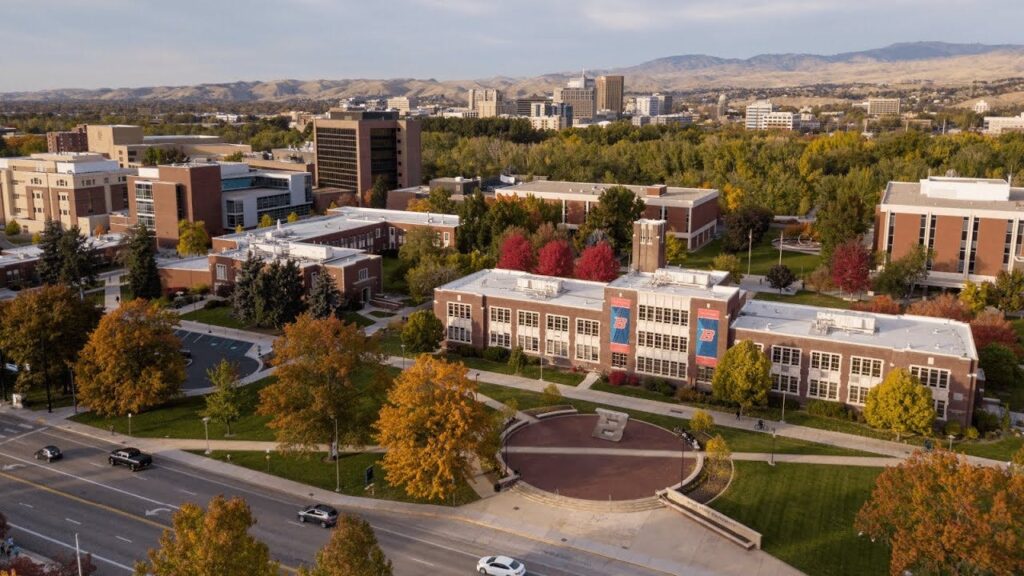
    Across the street from the campus is the St. Paul Catholic Student Center, and this seemed like a great place to start. This might be an ideal venue to incubate the project, get feedback, and learn how BSU students might react to it. I went to the student center, and was immediately told that I am too old to be welcome there. It was a remarkably rude rejection, and immediately lowered my opinion of the center and those involved in it. I then sent a letter to the pastor, Fr. Dail, explaining that the Gospel of Luke presentation would be my senior project, and asking if the St. Paul student center might be a venue for developing it. His rejection was categorical. They were not interested.

    This was both surprising and insulting. I am not sure what motivates that group, but clearly it would not be worth putting more effort in that direction.

    I wrote a letter to the pastor of my parish church in Meridian, explaining my senior project, and asking if there might be an opportunity to perform there. There hasn’t been any response. There doesn’t seem to be any interest.

    These two places left me in deep doubt about the course I was pursuing. If my local churches weren’t interested, who possibly would be? 

    A man with a walking stick and backpack encounters a closed road in the desert.
    Image by Gemini.

    But at a third Catholic church, there has been interest. I expect to schedule a presentation in the next week or two, for the first public performance of the Gospel of Luke. And the audience might include local school officials, who can then judge if it would be a good program for their schools. 

    I think this is an important project, with real value. That conceit is what keeps me pushing for options, even when some doors remain closed. Rejection was temporarily demoralizing, but my attitude is that I am making an offer, and those who reject are losing a valuable opportunity. Development may be slow and halting, but there is no other path but to push forward.

  • Memorize and Recite: Is This a Career Path?

    Memorize and Recite: Is This a Career Path?

    The Gospel of Luke and the search for an audience.

    It seems like the Gospel of Luke could use some flair. Costume choices, blocking, maybe a compelling set, and flexible, dramatic lighting. These things, with some talent and experience, might make it into a sort of extravaganza.
    But then there are considerations of mobility and flexibility. Will the show require a moving van full of set pieces and gear and costumes? Where can it be parked? As equipment deteriorates and breaks, will it be easily replaceable? What if a costume gets a tear, or a stain? Do I have the sewing skills to deal with that? What about the price of gas?

    It would be so much easier to travel light, and to rely on my voice more than any visual component for the presentation. I would like to perform in local prisons, and you generally can’t bring things inside. There something very appealing about requiring very little, and being maximally flexible.

    Looking over these options, the question arises of what exactly I am trying to do. Thinking this over, I have memorized something and the hope is that there will be some demand for it to be recited.

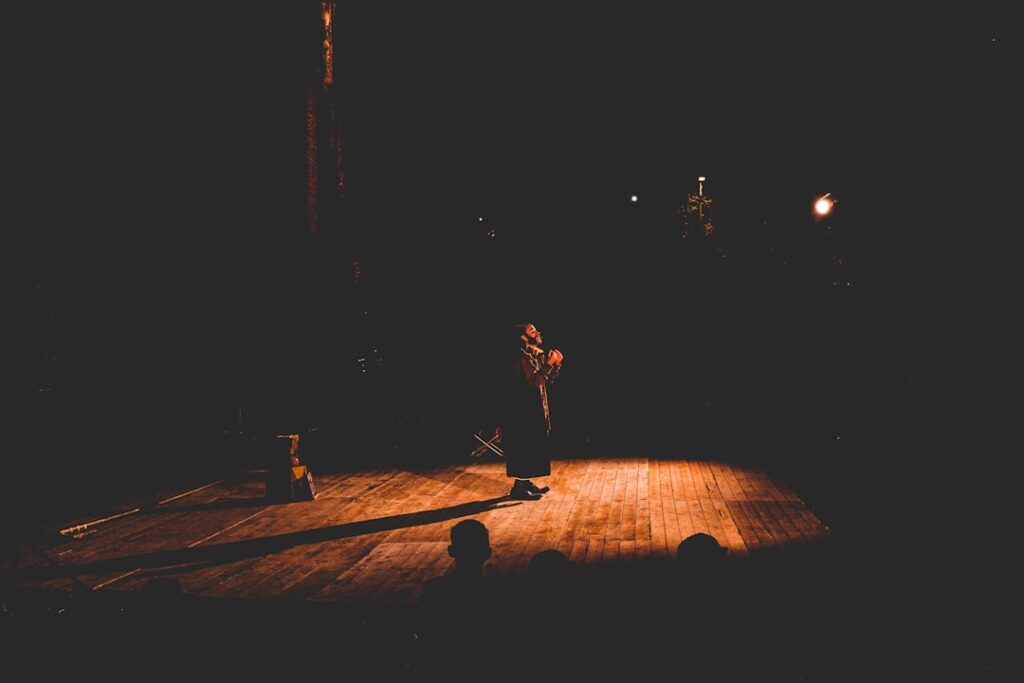
    A single, dimly lit performer on a theater stage.
    Photo by antonio molinari on Unsplash

    This is a stripped-down understanding of what it is to be an actor, but it’s pretty accurate. This defines theater, in a simple, clear way. There is the decision process of determining what should be memorized, and then efforts to recite the memorized thing in a way that makes people happy.

    My decision to memorize the Gospel of Luke makes sense to me, and will make more sense to you as this Substack develops, as there are further chances to explain how this came to be. This is the first part of the equation. Now the recitation part needs to be addressed.

    Part of the recitation process is rehearsal, and the competence that comes with repetition. This is pretty well taken care of.

    The next problem, or challenge, is finding a venue to present this to other people. There have been some difficulties on that front, which I will explain in a future article. But something should open up this summer, with multiple opportunities for performance when school starts up in the Fall.

    Can one make a living in this way? Are people willing to pay to see a recitation? This is the test, and the innovation that I want to make real. 

    In looking how to develop the simple tasks of memorization and recitation into a career, it has been helpful to ask for advice from Artificial Intelligence. But there’s not many other avenues in which to incorporate AI into the process. It’s quite a basic undertaking, without recourse to shortcuts. What to memorize, where to recite?

    This story is developing, and if there is some success, I can imagine many ways it might be expanded into educational programs and incarceration programs and theaters and assisted living facilities. There is a lot of potential for venues, but that potential needs to be realized soon, as I try to develop this project.

  • Being an Older Student at BSU

    Being an Older Student at BSU

    Hopefully, a Good Impression Was Made

    There is something potentially unsavory in a an older man studying theater with young people. What could be his motivation?

    The theater students at BSU seem tame and well-mannered compared to my experiences at UCSB and at Carnegie Mellon. Those were a long time ago, but I remember quite a few larger-than-life personalities, reckless behavior, and extreme extroversion. There are advantages to learning with a more civilized group, but it is harder to get to know them.

    This year I have been a stranger, and maybe an odd stranger, to my fellow classmates at Boise State University. It helped that I was tasked with designing props for our production of Grease, to show that I am responsible and creative, taking tasks seriously. 

    I have made some very nice friendships, but not generally among the Theatre Arts students. I do hope that impressions of me have been positive.

    But there is only one year to go! This will pass too quickly! And what can be accomplished in this final year?

    That’s why my focus has been on a one-man show, something to develop in school, and then to take into the world. It seems the best strategy.

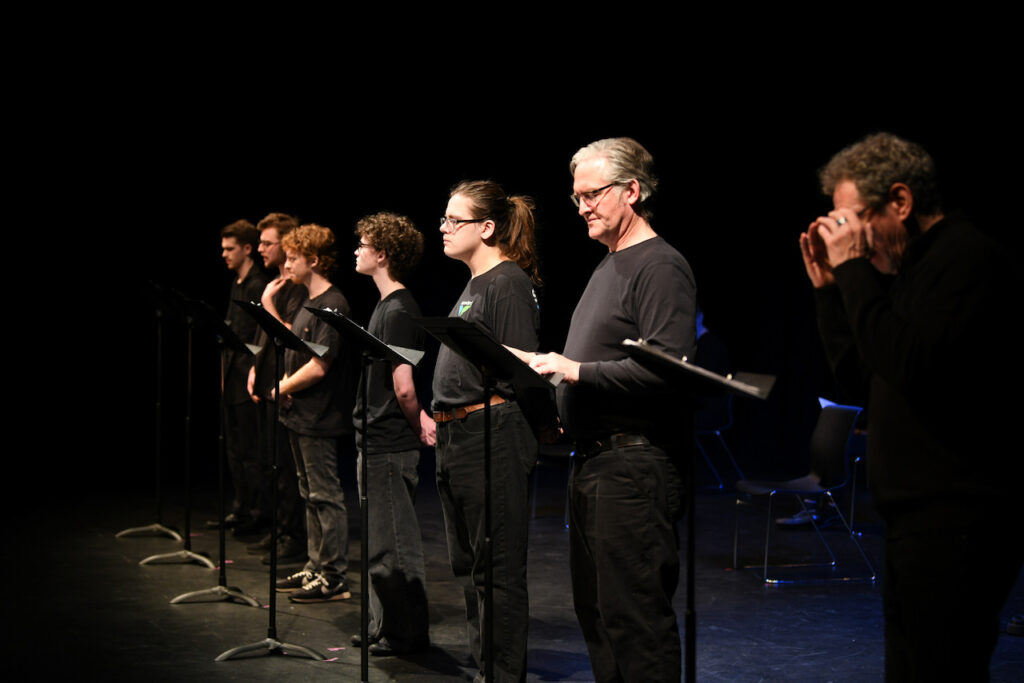
    A staged reading of The Life of Galileo at Boise State University.
    Photograph by Jonathan Collins Photography.
  • Why the Gospel of Luke?

    Why the Gospel of Luke?

    My History of Memorization

    Around 1980, I went to South Junior High School in Nampa, Idaho. Somehow I conceived the idea of memorizing an essay by Woody Allen, “My Speech to the Graduates.” I do hope my drama teacher was pleased when I asked if I could recite it to the class. She agreed, and thus began a lifetime practice of memorizing things.

    It’s not that I accumulated a storehouse of memorized pieces. It was sporadic, and after I had completely forgotten one, I would start on another. And it wasn’t necessarily for an audience. It was an activity that somehow gave relief, an exercise that was satisfying and possibly beneficial.

    And the texts haven’t been religious, except for this one and the one before it. I was an audio engineer at a Krishna temple before returning to Catholicism. While at the temple, I became very interested in their scriptures, and this led to memorizing the story of Prahlada Maharaja, and his father Hiranyakashipu. It was the longest text I had ever memorized, spoken in one hour and six minutes. The only time I recited it for another person was with a friend on a drive to see a white buffalo born in Wisconsin.

    When I returned to Catholicism, I read the entire Bible, with an idea that I might memorize something from it. It seemed logical to focus on one of the Gospels, and Luke somehow seemed most appropriate. But I didn’t realize how long this Gospel is. Only a third of the way in, it was clocking at over an hour. I thought it best not to memorize further, at least for now.

    A winged bull, in the style of an illuminated manuscript.
    Image by Gemini

    The Gospel of Luke is memorized, up to chapter 9, verse 50. This is a transition point to what is called “Luke’s Travel Narrative,” where Jesus determines to go to Jerusalem. The run time is about an hour and fifteen minutes.

    Having spent some years at the Krishna temple, in an Indian culture, I saw appreciation for feats of memory, with Vedic chanting proclaimed a Masterpiece of the Oral and Intangible Heritage of Humanity by UNESCO. (UNSESCO, 2026, Tradition of Vedic chanting, https://ich.unesco.org/en/RL/tradition-of-vedic-chanting-00062).

    Perhaps this effort of mine can find a place within that milieu, but it seems best to first focus on this small thing I have memorized, find a place for it in the world, and then think about its growth.

    This recitation of the Gospel of Luke is my senior project at Boise State University. In the class, Preparation for Senior Project, I received the go-ahead for this work. But a challenge is to find a venue where it is appropriate and appreciated.

    The first difficulties have arisen with finding the first venue. It has yet to be performed publicly … stay tuned.

    But any worthwhile project will have its challenges, and more are expected. If I can focus on the goals of my senior project, and be unflagging in the search for venues, things should work out. This Substack will document this effort.

  • About that Idaho theater career…

    About that Idaho theater career…

    Sobering Research on Career Outcomes

    In my second semester at Boise State University, I was required to write a research paper for English 102, a core requirement for graduation. We were to decide what the research paper would be about, and I chose Career Outcomes for Theatre Arts graduates in Idaho.
    Statistical outcomes were drawn from the U. S. Bureau of Labor Statistics and The Alumni Outcomes Project. I also interviewed Gordon Reinhart, a Theatre Arts professor at Boise State University.

    Arts boosterism is common everywhere, urging involvement in arts programs at every education level. The advantages to students are uncontroversial, with developmental opportunities not offered in other disciplines. But the decision to join the Theatre industry after graduating from college is fraught with concerns. This professional field is characterized by limited financial returns, unstable and short-term work contracts, a willingness to commoditize one’s social presentation, and ongoing encroachment by advanced computer technology. This is not a field suitable for every person. Arts education should include frank discussions of likely career outcomes if this is to become a professional path. Given the various and obvious difficulties of maintaining oneself in the theatre industry, reliable data and potential strategies need full examination.

    The arts in general tend to be promoted as a public good, as a cornerstone of culture. Often ‘vibrant culture’ is assumed to benefit whatever community is exposed to it. Theatre Arts are ancient and ubiquitous, to be found in Indian temples, modern German facilities, and within the curriculum of most American schools. But while the art itself is considered to convey cultural worth, a capitalist society often correlates value with financial remuneration. Here a discrepancy arises between assumed value and transactional value, and it is here that the serious student of Theatre Arts must assess the practicality and inner need for this kind of professional pursuit. The merit of professional involvement in Theater is not being disputed, but financial considerations should be realistically assessed by those considering this profession.

    Live theater, as an industry and a career path in Idaho, is extremely limited. Recent state data from the U. S. Bureau of Labor Statistics estimates there are approximately 35–41 professional actors and 357–412 producers and directors currently employed in the state. The median wage for actors is between $18 and $25 per hour, and this pay tends to be contract-based, meaning that employment is limited to the duration of a theatrical production. Producers and Directors have more employment opportunities, with a median wage of $57,050 per year.

    A poorly clad young man with empty out-turned pockets walks a street in Southern California, behind him is a sign that reads: Auditions, Acting Studio.
    Image by Gemini

    A mean wage between 18 and 25 dollars per hour makes actors financially comparable to hand laborers and material movers, or simple unskilled labor. Given the temporary nature of theater employment, it is not surprising that the most skilled and experienced professionals in this field still regard the profession as a hobby.

    There are three theaters in Idaho with standing contracts to hire professional actors, stage managers, directors, and choreographers. These are the Idaho Shakespeare Festival, which is the largest, Boise Contemporary Theater, and Coeur d’Alene Summer Theatre. Various other state venues have labor agreements with the International Alliance of Theatrical Stage Employees. While the performers in these latter cases might be touring or a local group, the labor behind the scenes is unionized.

    Professionals tend to recommend against joining a performance union in Idaho. There are limited union positions available in the state, and joining a union severely restricts the roles for which one might be eligible.

    Non-union theater work is more common. However, working outside of a union subjects one to low or no pay, lack of any employment benefits, and work limited to the duration of a production or a project. One cannot expect to make a living wage outside of union protections in the theater industry.

    Because these union positions are so limited in Idaho, they tend to be held for long periods of time, and may be filled from out-of-state applicants. Acquiring one of these positions might be a long-term strategy, but this does not solve short and medium term needs. A recent class at BSU held discussions with a director from The Idaho Shakespeare Festival. She mentioned that this is quite a busy time for her, and that she would be traveling to Los Angeles the next morning to audition actors for the Idaho Shakespeare Festival. One can see the difficulty of making a living as a performer in Idaho, when candidates for the largest local union theater are hired from out of state.

    This situation presents a conundrum to the Idaho performer: To join the union and face restricted job prospects, or to remain outside of the union and not qualify for higher pay or benefits.

    There is no danger of theater disappearing in Idaho. There are stages continually in use, particularly in educational institutions. But it is not practical, except in the rarest of circumstances, to consider theatrical performance a realistic career path in Idaho. However, teaching is a viable option. Higher education and academic administration compose the pinnacle of stability for theatre professionals in the state. These roles typically require an MFA or significant professional achievement. They tend to start between $58,000 and $65,000 per year.

    Gordon Reinhart is a professor of Theatre Arts at Boise State University, with an extensive resume of theatrical experience in the United States and Europe. We sat for an interview about the Theatre Arts employment situation in Idaho. He flatly states that theaters cannot be profitable, because the live experience cannot be mass produced, as film or video might be. This is a profession, like many artistic professions throughout history, that relies on the wealth of patrons. In his current situation, the university is his patron, acting like a count or duke who says, “You can work in theater but you must also work for me.” To regard the theater industry as a source of secure employment, according to Professor Reinhart, is to misunderstand the dynamics of the theater industry. (personal communication, 2026).

    Other states, and other cities tend to be destinations for those committed to working in the theatre industry. New York City is the most promising place in the United States for a stage career. Other places that might support this career path include Chicago, Minneapolis-St. Paul, Washington, DC, Seattle, and Philadelphia. But even in these more promising metropolises, a life in the theater is not considered an easy path.

    The highest paying roles in the Idaho theater industry are in technical theatre and production management roles. These include lighting, set, and costume designers, stage managers, and producers. These roles require skills that are easily transferable to other industries, and can keep one engaged in the theater world.

    Outside of teaching positions and technical theater roles, the career outlooks for Theatre Arts graduates can be discouraging. The industry is otherwise characterized by temporary placement, low pay, and limited opportunities. However, for a few individuals, this truly is a calling, a necessary form of artistic expression and fulfillment.

    For a Theatre Arts graduate from Boise State University, the best way to secure income in Idaho is not a single job, but an employment strategy that balances stability with higher paying, short-term gigs. Because of this dynamic, the search for employment must remain ongoing. If in the scramble for employment and income, one is fortunate enough to become established in a stable theater role, then one can probably be considered a success.

    It can be argued that formal education in Theatre Arts develops skills that are useful across a wide variety of fields. Theater training particularly involves collaboration, public speaking, and creative problem solving, which are highly valued in the corporate and non-profit sectors. And often, a source of income outside of Theatre is necessary to maintain one’s involvement within it.

    Theater without financial profit is ubiquitous and a permanent cornerstone of our culture. Lucrative and stable employment in this field is problematic and difficult, but for the committed Theatre Arts graduate, survival in the industry is possible.